Is Artificial Intelligence undermining Freedom of Information?
AI-assisted Freedom of Information requests are rising, creating new pressures for public bodies. But new research finds little evidence of the feared flood – and warns that concerns about AI could become a pretext for restricting the public’s right to know.
By Ben Worthy, David Cuillier, Sheeley Kimball and Suzanne Piotrowski

There is growing concern that Artificial Intelligence is undermining Freedom of Information laws, and that ‘bots’ can be used to ‘flood’ or overwhelm public bodies with requests.
In 2023 Wired magazine reported widespread worries that AI bots could flood FOIA officers working in elections in the US, claiming that ‘Election Workers Are Drowning in Records Requests. AI Chatbots Could Make It Worse’.
In 2025, the Australian Attorney General proposed a series of restrictions to the Australian Federal FOI law, arguing that ‘technology [is] enabling large volumes of vexatious, abusive and frivolous requests—tying up resources, costing taxpayers money and delaying genuine requests’, and citing claims of ‘FOI bombing’ of particular agencies.
The UK government also recently floated the possibility of altering cost limits, again with a hint that AI was driving increased requests. In June 2026 the Scottish Information Commissioner spoke of the ‘potential challenges posed by high‑volumes of AI‑generated requests’ meaning ‘excessive or automated submissions can place considerable strain on organisational resources’.
Neither the fear of FOI floods, nor the use of automated requests, are new. FOI templates have been around for many years, if not decades. This ‘FOIA the Dead’ bot has been running since 2017, firing off an FOIA request to the FBI whenever an obituary appears in the New York Times. But there is now genuine concern that public bodies are at risk of being overwhelmed.
How many AI assisted requests are there?
To find out exactly what was happening, we ran two online surveys of UK local government FOI officers, asking about the numbers and impact of ‘AI assisted FOIs’. The first survey ran in January 2025 with a follow up in January 2026. The phrase ‘AI assisted’ was used to cover a range of possible actions, from those using AI to ‘polish’ requests all the way to fully automated use.
The data comes with a qualification, namely that identifying AI use is hard, and getting harder. We don’t know much, only that a very small percentage of people use AI to search for FOI information. FOI officers were reliant on certain signs to spot where AI had happened: possible clues included identical or similarly worded requests, or the arrival of similar requests in a short space of time. But knowing for certain is difficult, especially as the technology evolves in leaps and bounds.
Is there a flood of FOI?
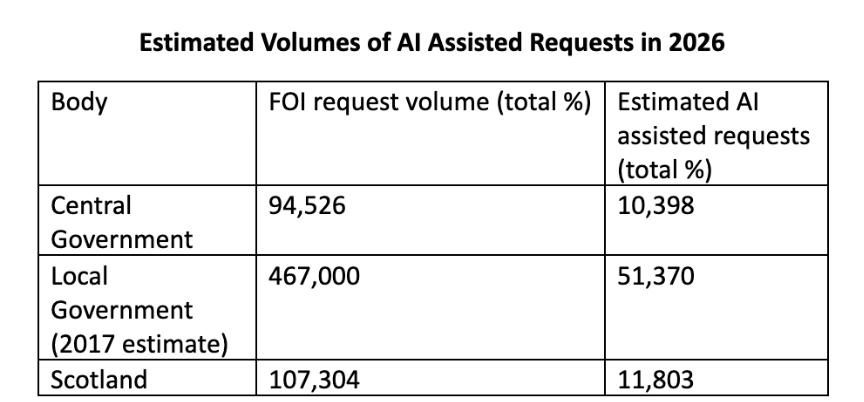
There is not, so far, any floods or FOI bombing. In 2026, the average estimate was that 11% of requests use AI in some way, up from the 5% in 2025. In terms of patterns, there were no huge waves but surges in the space of hours or days. Officials spoke of ‘150 in 24 hours’ ’20 in a few hours’ or ’18 in day’.
At first glance, this may seem rather far away from some of the worst-case scenarios of 600 requests in a few hours, but these percentages need to be seen in context. FOI requests in the UK having been growing, with 94,526 to UK central government in 2025 and 107, 304 FOISA requests across all Scottish bodies for the last four quarters. So, it is 11% of a large number.
There was a sense that the trend was moving rapidly upwards. More UK FOI officers believed they have received AI assisted requests in 2026 than in 2025, with 72% believing they had them in 2026 compared with 38% in 2025.
There was also an important unknown. Are these 11% of requests already intended to be made or were they a result of AI suggesting it? FOI officers made a distinction made between AI assisted requests and AI prompted. One officer explained that some ‘requesters …used AI to write a request when they know what they want but not how to ask for it’ whereas others ‘made a search for something and the AI search engine has suggested making a FOI and written it for them’. We don’t know if these 1 in 10 requests are part of the overall numbers or in addition to them.
Hidden costs?
As well as the increased volume, there are several hidden costs, hitting different parts of the system.
First, on a day-to-day level, AI assisted requests take more time to deal with than ‘normal’ requests. One FOI officer explained how requests ‘obviously written by AI’ were ‘significantly longer, broken down into sections with multiple bullet points, and occasionally quote legislation, some of [which] doesn’t actually exist’. Another spoke of how they were ‘verbose, voluminous and spread across multiple departments, or the whole authority’. These descriptions fit with the ICO’s experience, who warn that AI requests are often ‘very long, repetitive’ and ‘have a greater scope’. The problem is made worse by the fact that many contained errors and hallucinations: ‘AI requests’ often ‘muddle things’ and ‘we then have to unpick and explain’.
Second, in the UK AI is being used for Internal Reviews and Appeals, as well as requests. The SIC found that AI had ‘supported the submission of high volumes of ‘machine-generated’ FOI reviews and appeals, with little evidence of direct human involvement’, and ‘in one two-month period…the Commissioner received 120 appeals from just two applicants, with evidence that those appeals were entirely generated through the use of AI’.
Overall, this meant, as one officer put it, a ‘tangible cost associated with this additional burden—both from the longer, more detailed requests…and from the extra effort required to address any valid points they contain’. This included time spent working out what was wanted, as well as contacting the requester.
The picture was not wholly negative. One spoke of how AI assisted requests were sometimes ‘clearer than those written by humans’ and that ‘AI assisted requests usually make sense and are legibly written with fewer grammatical errors and fewer ambiguities’. Others were less convinced AI caused any added burden, in the context of rising levels of requests to local government: ‘It’s just a request and the request would have been made irrespective of a requester using their own words or seeking AI to assist’. Another wrote of how it was ‘no more burdensome than any other FOI’.
What action are public bodies taking?
For those facing surges, FOI officers have a series of potential tools to use against AI driven requests, including cost limits and-in the UK- the ability to ask a requester to provide a name and address or declare a request vexatious.
The survey pointed toward a series of solutions, many of which were already being employed. A number of FOI officers had already used section 8 (1) (B) to ask the requester to confirm their identity, with one saying ‘all were refused because no real name provided’ and another that ‘where they are an AI bot and we have been able to catch this, we refuse and ask for ID to make sure they are a genuine request’. Other respondents mentioned cost limits and sections on vexatious requests, as well as the UK duty to ‘advice and assist’ requesters. As one put it ‘we spend more time now…asking them to hone their requests’
Interestingly, when asked, the public showed some support for restrictions on AI use relating to FOI. In a 2026 poll for the Scottish Information Commissioner, only 13% believed AI use for FOISA requests should be ‘unlimited’ while 38% ‘believed that people should not be allowed to use AI when requesting information from Scottish public bodies’ and a further 33% took a more balanced position, indicating that AI use should be permitted ‘but subject to certain limits’.
As ever with FOI, there is some politics lurking within. While AI is clearly causing a strain, claims about AI and bots are already being used as an excuse to clampdown. In Australia and the UK, governments tried to hint not just as floods, but that AI bots were somehow linked to foreign actors attempting to abuse the law. Despite the strong allegations, the Australian government struggled, when pressed, to find firm evidence of floods and ‘FOI Bombing’. The problem is that, alongside dealing with the new challenges of AI, we need to be aware of the old story of hostility and restrictions that can hide behind it.